27 June 2009
Epicurus at the Painted Porch
12 June 2009
God's Problem: Book Response
06 June 2009
Tending the Natural: Humanist Spirituality II
- The Art of Living, Sharon Lebell. A modern translation of Epictetus' Handbook and Discourses.
- The Art of Happness and Ethnics for a New Millenium, Tenjin Gyatso (the 14th Dalai Lama).
- Doug Muder's "Humanist Spirituality"
22 May 2009
The Six Security Beliefs
-------------------------------------------------------
"But knocking wood is only one example of a class of notions, so comforting and so productive of feelings of security, that men will seize upon them on the slightest provocation or none at all. Any piece of evidence tending to support such a 'Security Belief', however frail and nonsensical it might be, is grabbed and hugged close to the bosom. Every piece of evidence tending to break down a Security Belief, however strong and logical that evidence might be, is pushed away. (Indeed, if the evidence against a Security Belief is strong enough, those presenting the evidence might well be in danger of violence.) [...] I have come up with six very broad Security Beliefs that, I think, blanket the field -- although the Gentle Reader is welcome to add a seventh, if he can think of one.
Security Belief No. 1: There exist supernatural forces that can be cajoled or forced into protecting mankind. "
(Here Asimov addresses the possible root of such a belief, the capriciousness of natural events, their importance to hunting and agricultural societies, and thus the importance of being able to control those forces. )
"Security Belief No. 2: There is no such thing, really, as death."
Asimov details the fear and denial of death and explores some of its offspring -- spiritualism, for instance.
"Security Belief No. 3: There is some purpose to the Universe.
After all, if you're going to have a whole battery of spirits and demons running the Universe, you can't really have them doing it all for nothing. [...]"
"Security Belief No. 4: Individuals have special powers that will enable them to get something for nothing."
'Wishing will make is so' is a line from a popular song and oh, how many people believe it. It is so much easier to wish, hope, and pray, than to take the trouble to do something. [...]
Security Belief No. 5: You are better than the next fellow. [...]
Security Belief No. 6: If anything goes wrong, it's not one's own fault." [...]
When the Security Believers are strung by the explosion of the hoaxes and follies that deceive them, what is there last, best defense? Why, that there is a conspiracy of scientists against them."
--------------------------
I have been unable to find a copy of this essay online: I would like to be able to link people to it. It is contained in the posthumous collection Magic: The Final Fantasy Collection, which is a bit ironic. Magic consists of stories by Asimov that have been labeled as fantasy as well as essays on fantasy fiction, fantasy, science fiction, and other unrelated topics.
06 May 2009
What I Learned from Hippies
You hold the key to love and fear, all in your tremblin' hands...
Just one key unlocks them both, it's there at your command...
C'mon, people now, smile on your brother --
Everybody get together, try to love one another right now. - "Get Together", the Youngbloods
One of my monthly pleasures while growing up was riding to the state capital, where my parents and I would enjoy the advantages of the 'big city" -- for my parents, stores, and for myself, the zoo. The state capital, the closest "big city", was an hour away and along the way, we would listen to what my father termed "oldies": rock and folk music from the fifties and sixties. Since we were fundamentalist Pentecostals, I was barred from listening to 'worldly', or non-church, music. My father relaxed the rules when it came to the music of his youth, however, and so his childhood bands became my childhood bands. My mother, much more conservative in that area than my dad, would be very uncomfortable at this prospect, but grudgingly admitted a certain affection for the Monkees. Although I relished in all of the music -- it was, aside from sneaking around and listening to country music when my parents weren't around, my only source of "real" music -- I especially liked the folk songs done by the beats and "hippies".
Their message -- peace, love, tolerance, and understanding -- was very attractive to a social misfit like myself, much the target of bullying and jeers. In retrospect I can't say I regret that those things happened to me: for whatever reason, they gave me a humanist heart and I have benefited enormously from the lessons learned. My appreciation for the message of the hippies grew when I hit high school and learned what the counterculture was actually about. Although since childhood I had regarded the 1960s with very romantic eyes, understanding the racism, intolerance, and indifference of the conservative fifties made me realize how necessary the hippies were. Although I was subscribing more and more to my parents' religion and becoming even more fundamentalist than they in certain aspects of my life, I found myself preferring the world of the hippies. Even though I wanted the typical suburbans dream, I could understand why the hippies wanted to get away from it.
As I've grown older still, my relationship with hippies has become more complicated. I've since learned about the drug abuse, for instance, and how they popularized horoscopes and so on. At the same time, as I have grown -- have started to question consumerism and have started practicing a philosophically spiritual life rather than a religiously dogmatic one, my appreciation for them has grown in those aspects. I understand the motivation behind the "back to the land" movements, and as something of a free spirit myself, I 'get' living outside cultural norms. Although the way I have looked at hippies has changed, I still love their music.
Some of songs I regarded as"hippie" songs from my childhood:
- "Get Together", the Youngbloods
- "For What It's Worth", Buffalo Springfield
- "Turn, Turn, Turn", the Byrds
- "California Dreamin'", the Mamas and the Papas
- "Blowin' in the Wind", Bob Dylan
- "All You Need is Love", John Lennon/the Beatles
- "If You're Going to San Francisco", Scott McKenzie
03 May 2009
Wild Geese
You do not have to walk on your knees
for a hundred miles through the desert repenting.
You only have to let the soft animal of your body
love what it loves.
Tell me about despair, yours, and I will tell you mine.
Meanwhile the world goes on.
Meanwhile the sun and the clear pebbles of the rain
are moving across the landscapes,
over the prairies and the deep trees,
the mountains and the rivers.
Meanwhile the wild geese, high in the clean blue air,
are heading home again.
Whoever you are, no matter how lonely,
the world offers itself to your imagination,
calls to you like the wild geese, harsh and exciting —
over and over announcing your place
in the family of things
27 April 2009
Abounding Grace
==================================================
13 April 2009
Walking through Suffering
I realized early this morning that doing these things would be difficult. How could I endure aerobics class, for instance, if I couldn't even hold a cup of hot tea without my trembling spilling it on the table? After having breakfast and realizing that I wasn't going to be feeling better anytime soon, I decided to send my teacher an email telling her I wouldn't be there and trembled my way across campus to the university library, where I finished my paper and studied for German. The morning passed, and I felt oh so miserable. By the time 12:30 had arrived and I was leaving the office for lunch, I thought to myself "You know, I think if I found a handgun I wouldn't even wait to write a note!"
At lunch, I sat myself and pondered my situation. I still had so much to do -- how was I going to make it through the day? What I really disliked, beyond the physical pain and "Oh, just shoot me" feelings, was how the suffering had eroded my ability to interact with people. I found myself trying to get irritated or angry at trivial things (like the sound of someone walking behind me). I was also having to deal with feelings of paranoia. People kept staring at me, or so I thought, and I kept going to the rest room to check my zipper to make sure it wasn't open. When I began feeling irritated at two professors quietly talking, I knew I had to do something.
According to The Stoic Life, the Stoics believe that everything that happened to us left an impression upon our consciousness, but that we could "give assent to" or "Deny" those impressions. "Denying" the idea that people were staring at me because my zipper might be open was one thing, but denying my mental suffering was quite another. I knew it could be done, though. As far as I know, there are two types of pain: physical pain, as received through our nervous system, and mental pain. Mental pain, or suffering, can arise from both physical stimuli (a hammer hitting our thumb) or emotional stimuli (the loss of a friend). If suffering is in the mind, then I can deal with it -- disarm it. But how?
After lunch I had planned on walking through town to my local library for my weekly visit. My fatiuge had made me wonder if I shouldn't just go later this week, but I value my books to the point that I decided to stick it out. Leaving the dining hall and trailing behind the two whispering academics who had annoyed me so much, I decided to do something. I decided to sing to myself. "It's a good day...for shinin' your shoes, and it's a good day...for losin' the blues..."
While the song is one of my favorites, the lyrics refused to come to me. I continued walking -- and then tried again. "What did Dela-ware, boys, what did Dela-ware? What did Dela-ware, boys, what did Dela-ware? She wore her brand-new Jersey, she wore her brand-new Jersey, she wore her brand-new Jersey, and that's what Dela wore..."
It didn't seem to be working, and singing tired me. I continued, though, because there was nothing else to do. "Why did Cali-phone ya, why did Cali-phone ya? Why did Cali-phone ya, was she all alone? She called to say how-ah-yah, she called to say how-ah-yah, she called to say (Hawaii) and that's why she did phone!"
I continued singing softly to myself, stopping when I met a friend coming back from the library. We spoke a little and I went on my way, singing "How did Wiscon-sin, boys? She stole a new-brass-key. Too bad that Arkan saw boys, and so did Tenne-see! It made poor Flori die boys, it made poor Flori-die you see, she died in miss-our-i boys, she died in misery!"
And there I was, walking across the park to the library and I was feeling not "good", but...a lot less bad than I had before. The suffering had diminished. Thrilled, I continued humming to myself until I arrived in the library, at which I stopped as they generally frown on such things. I got my books, and noticed that one of them was not what I had expected. A week ago, while searching for "world religions", I found a book called "Embroidered Textiles". Then I was somewhat entranced by the title, thinking to myself that the author was going to look at the rich tapestry of human religious and spiritual experiences and then show to us the patterns hidden within. What a marvelous metaphor! I was quite looking forward to it. Imagine my amusement, then, when I opened the book to find that it was about actual textiles -- blankets, cloaks, and so on. I laughed for a while, and as I did realized that the suffering had diminished even more.
On my walk back through the park, I noticed a tennis ball. I made a sound of glee -- two weeks ago I'd found a similar tennis ball and had for a week kept it on my person for impromptu games of handball. I lost it last Sunday while throwing it against a building and catching it, because it hit a gutter pipe and bounced off at an odd angle into a trench that I couldn't access. And so there I was, walking back home, singing to myself, bouncing the tennis ball against the wet pavement. I had a headache and was still very much tired,but my suffering was gone. I had denied it through my behavior, and now felt strangely energetic and playful. Such is the power of the mind and mental denial.
And here is another thought: were I still in my parents' religion, I probably could have accomplished the same by singing a song of praise. Then, however, I would have interpeted what happened as being the work of God, who rewarded praise for relief from mental anguish. Either there's power in singing gaily, or Perry Como rewards those who keep his memory alive by singing his old songs.
If you want to hear the song I was singing, here it is below.
06 April 2009
The Words of Martin Luther King Jr.
========================================================
"An individual has not started living until he can rise above the narrow confines of his individualistic concerns to the broader concerns of all humanity."
02 April 2009
Robert Green Ingersoll: a Tribute
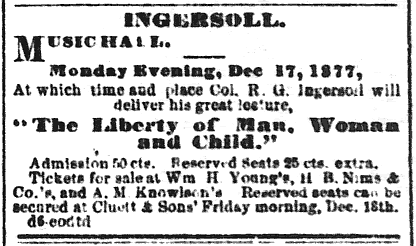
- "The Liberty of Man, Woman, and Child"

Few people have heard of the man whose image has become my avatar on blogspot. His name is Robert Green Ingersoll (1833 - 1899), and he was an extraordinary man. Although raised in the early 19th century, his opinions and values were "24th" century -- Star Trek fans will take my meaning. He was raised by an abolitionist preacher, and although he did not share his father's religious beliefs, he certainly shared his father's gift for oratory. While he made his living as a lawyer and state attorney general, he was known in his day for his oratorical abilities. Mark Twain raved about him; the New York Times took notice of him. His talent may have been partially genetic and partially learned: some biographies attribute his spell-binding oratory to his early experience in the law. * He drew crowds, attracting the attention of far better known men like Samuel Clemens and Thomas Edison. Clemens may have borrowed examples and arguments from Ingersoll's own work. Although not exactly a champion of the working class -- he believed labor and the owners of factories were not fundamentally at odds with one another, and stated that he did not believe in Socialism or Communism -- he urged for fair and safe conditions. (On a minor note, he said this before the 20th century dawned in a time when those words had different meanings. While he advocated fair conditions for workers, he also promoted equal rights for blacks and "east Asian" immigrants to the United States in a time where their civil liberties and rights were severely curtailed. His sterling example shames his peers. Their prejudices cannot simply be excused by murmurs of "Well, it was the times..". His life sees him standing tall, towering over others.

Given the scope of Ingersoll's life, it is difficult to approach a tributary essay to him. The best approach I have found is to present him as a champion of liberty. It penetrated the man: it shaped his politics, his ethics, his parenting style, his efforts to find truth and meaning in the world. It was, I think, his watchword. He devoted at least one speech -- "The Liberty of Man, Woman, and Child" -- wholly to the subject, applying the principle to seemingly every aspect of life he could think of. He was passionately devoted to the idea that people -- men, women, and children -- should be able to think for themselves, to discern the truth as best they could find it. "I have never claimed to know the truth," he said, "Only that there are things I believe to be true." Even those who disagreed with him could not help but admire the eloquence of his arguments: "The plea for liberty was sublime. [...]Freedom of speech, and of thought were never battled for in more manly fashion," reported the Troy NY Daily Press upon his delivery of it. It was in "The Liberty...." that he delivered the words that first enraptured me:
"If there is a God who will damn his children forever, I would rather go to hell than to go to heaven and keep the society of such an infamous tyrant. I make my choice now. I despise that doctrine. It has covered the cheeks of this world with tears. It has polluted the hearts of children, and poisoned the imaginations of men. It has been a constant pain, a perpetual terror to every good man and woman and child. It has filled the good with horror and with fear; but it has had no effect upon the infamous and base. It has wrung the hearts of the tender; it has furrowed the checks of the good. This doctrine never should be preached again. What right have you, sir, Mr. clergyman, you, minister of the gospel, to stand at the portals of the tomb, at the vestibule of eternity, and fill the future with horror and with fear? I do not believe this doctrine; neither do you. If you did, you could not sleep one moment. Any man who believes it, and has within his breast a decent, throbbing heart, will go insane. A man who believes that doctrine and does not go insane has the heart of a snake, and the conscience of a hyena."
When I read those words, I think of the poem "Invictus": "It matters not how strait the gate, how charged with punishments the scroll: I am the master of my fate; I am the Captain of my soul." Such was Ingersoll's conviction that he could stand tall, proud, and defiant in the face of not utter destruction, but utter misery -- the purported "flames of Hell". He made a choice -- such was his love for compassion and liberty that rather than submit to the rule of a being who would punish someone for "thinking an honest thought", he would embrace the chance of that misery. There's something noble in standing firm for one's ideals in the face of power that urges one to write them off. A critic might say that it was easy for Ingersoll to utter these words given that he was an agnostic who had no belief in the afterlife -- only a faint hope that there might be one. But Ingersoll stood for his convictions in this life. When offered the chance to run for the governorship of Illinois if only he would stay silent about his religious views, he waved opportunity off: "Goodbye, gentlemen! [...] My position I would not, under any circumstances, not even for my life, seem to renounce. I would rather refuse to be President of the United States than to do so. My religious belief is my own. It belongs to me, not to the State of Illinois. I would not smother one sentiment of my heart to be the Emperor of the round world. "** Ingersoll stands as a standing rebuke to those politicians who assume religions they do not have -- who deceive in the quest for power.
I was almost hesitant to include Ingersoll's defiant words, knowing that for some readers this essay is their first exposure to the man. It was not feelings of intellectual superiority that set fire to his blood and moved him to utter those words. It was, I think, his compassion. The severity of his defiance above is matched by the depth of his love for life and joy. The same man who scoffs at delusions of god-given supremacy and moral superiority is the same who pleads with his readers to have a heart, to not "deny the same liberties one claims for one's own self". His hostility toward the "frightful dogma of eternal pain" began -- as he elaborates in "Why I Am Agnostic" -- when his father took him to a tent revival meeting and he heard a sermon on the agonies of Hell. So moving was this sermon that Ingersoll said he became the "implacable enemy" of the doctrine. He elaborates further: "The truth is that this belief in eternal pain has been the real persecutor. It founded the Inquisition, forged the chains, and furnished the fagots. It has darkened the lives of many millions. It made the cradle as terrible as the coffin. It enslaved nations and shed the blood of countless thousands. It sacrificed the wisest, the bravest and the best. It subverted the idea of justice, drove mercy from the heart, changed men to fiends and banished reason from the brain.
"Like a venomous serpent it crawls and coils and hisses in every orthodox creed. It makes man an eternal victim and God an eternal fiend. It is the one infinite horror. Every church in which it is taught is a public curse. Every preacher who teaches it is an enemy of mankind. Below this Christian dogma, savagery cannot go. It is the infinite of malice, hatred, and revenge."
It may be difficult for readers who have never lived under the idea of Hell to appreciate Ingersoll's motivation, to understand why he loathed this infinite hatred so much. I grew up in a world very much like Ingersoll's. The Pentecostal tradition in which I was raised hearkened back to those tent revival meetings. As a matter of fact, if you were to grace the doors of the church I grew up in, the first thing you would see hanging on the walls of the foyer is a painting depicting one of those meetings, with the fathers of the current Pentecostal movement depicted in profile. The sermon on hate that Ingersoll heard once bludgeoned me with its cruelty every week. It was only when I had grown callous to the threat of it that I could utter sentiments similar to Ingersoll's.
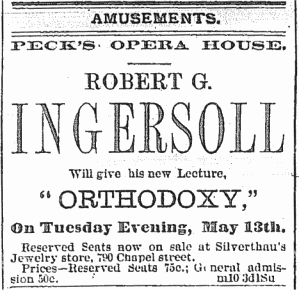
In another essay, "Orthodoxy", Ingersoll builds on his disdain for dogma. Here he dissembles the Nicene Creed while expressing his belief -- his hope -- that the religions centered around "things we not know of" would abandon their dogma and become religions of justice and compassion. He reveals a source for his contempt for doctrines and dogmas -- "My objection to orthodox religion is that it destroys human love, and tells us that the love of this world is not necessary to make a heaven in the next." Here we arrive at love, which I believe to be the root of a man, providing the basis for even his conviction to liberty. This is the love that guides him in his parenting style: the love for wisdom that sees him poring over the many books he talked about in "Why I Am Agnostic". Here, in this essay, he utters some of the most beautiful words I've ever heard -- words that belong in a wedding service.
Love is the only bow on Life's dark cloud. It is the morning
and the evening star. It shines upon the babe, and sheds its
radiance on the quiet tomb. It is the mother of art, inspirer of
poet, patriot and philosopher. It is the air and light of every
heart -- builder of every home, kindler of every fire on every
hearth. It was the first to dream of immortality. It fills the
world with melody -- for music is the voice of love. Love is the
magician, the enchanter, that changes worthless things to Joy, and
makes royal kings and queens of common clay. It is the perfume of
that wondrous flower, the heart, and without that sacred passion,
that divine swoon, we are less than beasts; but with it, earth is
heaven, and we are gods.

Ingersoll's flair for oratory has often made me think of him as a "secular preacher". One of his speeches I have is titled "A Lay Sermon", and here he shines. He promotes the same "spirituality" that the Dalai Lama writes about in The Art of Happiness: a commitment to human happiness. Happiness, Ingersoll states, cannot be found in anything but. To pursue wealth is to, in his words, pursue a "gilded hell". Money becomes one's captive. " That money will get him up at daylight; that money will separate him from his friends; that money will fill his heart with fear; that money will rob his days of sunshine and his nights of pleasant dreams. He cannot own it. He becomes the property of that money. And he goes right on making more. What for? He does not know. It becomes a kind of insanity." Ingersoll bucks attempts to pigeonhole him. He can't just be written off as god-hating bible-bashing atheist. I dare say that if I quoted those words in a Pentecostal church -- to an audience who had never heard of Ingersoll -- they would nod and chuckle. (I make an exception for the "prosperity gospel" believers.) Ingersoll once summed up his approach to life: "For while I am opposed to all orthodox creeds, I have a creed myself. My creed is this -- happiness is the only good. The time to be happy is now. The place to be happy is here. The way to be happy is to make others so." He expounds upon that simple creed -- which, by the way, you can hear him speak via sound recordings here -- in his "Lay Sermon", but the theme in general is interwoven throughout many of his works. In "The Foundations of Faith", he puts forth what he calls "The Creed of Science".
To love justice, to long for the right, to love mercy, to pity the suffering, to assist the weak, to forget wrongs and remember benefits -- to love the truth, to be sincere, to utter honest words, to love liberty, to wage relentless war against slavery in all its forms, to love wife and child and friend, to make a happy home, to love the beautiful; in art, in nature, to cultivate the mind, to be familiar with the mighty thoughts that genius has expressed, the noble deeds of all the world, to cultivate courage and cheerfulness, to make others happy, to fill life with the splendor of generous acts, the warmth of loving words, to discard error, to destroy prejudice, to receive new truths with gladness, to cultivate hope, to see the calm beyond the storm, the dawn beyond the night, to do the best that can be done and then to be resigned -- this is the religion of reason, the creed of science. This satisfies the brain and heart.
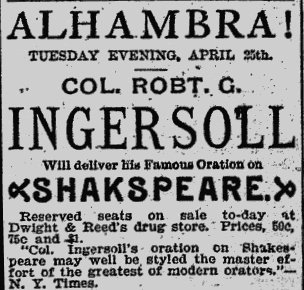
Note the source, an essay about faith. This is the beauty of Ingersoll. He isn't interested in just shouting down the preachers. However wrong he believes dogma to be, shouting it down isn't the point. "The more false we destroy," he once commented, "The more room there will be for the truth." This was a man who was not interested in sitting in a bar and grousing about the evils of orthodox religion. This was a man who runs to the churchhouse door, falls on his knees, pounds the door, and shouts "Stop, you're doing in wrong! In the name of love, you're creating misery! Can't you see? There's a better way." He railed against hate and dogma to create room for love and free inquiry. He was a humanist if there ever was one. He had no desire to make people unhappy, for he believed his own happiness lay in making other people happy. He had no desire to strip people of beliefs in heaven. He himself had "hope for the dead". But he could not accept a doctrine that would make -- in his words -- "the cradle as horrible as the tomb". Is it necessary, he asked, that heaven should borrow its light from the glare of Hell? Note also his term "religion of reason", and his commitment to both "Brain and heart". In his constant urging of people to think for themselves, he promoted the use of reason in our everyday affair. He was a man who celebrated intellectual progress and human achievements -- not just in science, but in literature as well. He was particularly fond of Shakespeare -- fond to the point of developing a lecture in which he praised the Bard's words.
There is so much more that could be said about Ingersoll. Part of what I like about him is his grandness -- he was interested in and talked about almost everything. Philosophy, politics, law, history, sociological critique, biology, literature, skepticism -- the man knew no bounds. He celebrated humanity, calling it the grand religion. His is a life that should be celebrated -- a name that should be known. Instead, in spite of his life, he has been consigned to obscurity. The reasons are not entirely known to me: he was one of the last orators in the so-called "Golden Age of Freethought", a man who fought the growing approach of dogmatic darkness in vain. The great Christian social movements of the late 1890s -- while perhaps giving him satisfaction that the churches were starting to practice the love they ought to have -- may have also dulled the bite of his criticism. Economic revival and the gilded age would have also made his criticism of seeking happiness through wealth unpopular. But he lived, and more importantly he lived well. He died as he wanted, with a family that loved him. They collected his speeches, ensuring that the lightening that once "glared around his words" was safely caught in a bottle for future generations to witness.
Such was the power of Ingersoll that even in print form, his speeches stir me. I have tried to express why he means so much to me that I would adopt his face as my own in this medium -- why I constantly often quote him, why I often hear his words. I can only hope that I have interested others in his life. The speeches collected are a goodly amount. Those I have quoted here -- "The Liberty of Man, Woman, and Child" and "Why I Am Agnostic", principally -- are good starting points. If you are reading Ingersoll for the first time, I cannot guarantee that you will be entirely comfortable. He was severe, but passionate -- gentle and loving but fearfully agressive at the same time. This is a man of whom Hamlet might have said, "He was a man -- take him for all in all. I shall not look upon his like again."
====================
Sources:
Ingersoll is quite quotable. He was an orator, and his available work reflects the medium, providing short quotations brimming with content. When I have quoted Ingersoll in the above essay, I have generally made reference to the work I'm quoting directly in the text. Those works are online for free at the Bank of Wisdom and the Secular Web Library. The two speeches I quoted most were "The Liberty of Man, Woman, and Child" and "Why I Am Agnostic", although I also drew heavily from "Orthodoxy" and "A Lay Sermon". Some of his work reflects developing opinions: during the economic depression of the 1870s, for instance, he is harsh in his address to the "working class". As the decades wear on and the abuses by the factories become more apparant, he is much more sympathetic and it is then that he defends them in "Orthodoxy" and "Eight Hours Must Come". Ingersoll could be quite eloquent, and I think his "Declaration of the Free" is an example of that. It also expresses his faint hope in an afterlife.Some of the more poetic bits of his speeches are presented on their own by the website "Positive Atheism". Do pay a visit!
* Robert Ingersoll, David Anderson
**Specific quote from Ingersoll the Magnificent, by Joseph Lewis.
Further Resources:
- The Ingersoll Chronology Project, from which I borrowed the newspaper images
- The Robert Green Ingersoll Birthplace Museum, including audio recordings. (Low quality, but one is fairly understandable and it served as my source for the "Happiness is the only good" creed quotation.)
- Robert Ingersoll at the Secular Web Library
28 March 2009
Philosophical Media
I found that through the "Related Links" section while re-watching a favorite series of videos, the Virtual University lecture on Marcus Aurelius, in which a classical historian delivers a lecture on the man and his philosophy. I have arranged the videos in a playlist. The first part is slow and is mostly background, but it really picks up during the second part.
User NLPNVC's videos are also of interest. Known as "NLP", he frequently posts videos in which he asks philosophical questions of his viewers and in which he tries to deal with ideas he's encountered, like "non-violent communication". In some videos, he addresses people whose approach and opinions he disagrees with, but tries to find some way to empathize with them. Sometimes he posts music videos about a particular theme, like "Hypnotized to Enjoy Violence". In one not-so-recent video, he asked people what they wondered about. The result is funny, and touching on some levels. This is a guy asking questions and trying to deal with people in a personal way, and I've found that his videos are not only provoking, but moving, as I said before. "All I'm saying with this video is...I wonder if you wonder like me."
11 March 2009
The Art of Happiness
================================
"I believe that the very purpose of our life is to seek happiness. That is clear. Whether one believes in religion or not, whether one believes in this religion or that religion, we are all seeking something better in life." - the Dalai Lama
"Happiness is determined more by one's state of mind than by external events." - Howard Cutler
"You can relate to [people] because you are still a human being, within the human community. You share that bond. And that bond is strong enough to give rise to a sense of worth and dignity. That bond can even become a source of consolation in the event that you lose everything else." - the Dalai Lama
"We [...] often add to our pain and suffering by being overly sensitive, overreacting to minor things, and sometimes taking things too personally."
"Honesty and self-confidence are often mixed."
"I believe it is essential to appreciate our potential as human beings and to recognize the importance of inner transformation."*
==================================
*By which he means using the practices of compassion, tolerance, and so on to better ourselves.
09 March 2009
Lot's Wife
=============================
|
08 March 2009
Gene Roddenberry, Star Trek, Humanism, and Me
==================================================================
I can talk about things now that would have embarrassed me once. And maybe my story could be helpful to you if you're somehow different from other people, or handicapped. Most of us are, in one way or another. I guess Star Trek had its first beginnings in the fact that as a child, I was different. Handicapped. I had difficulty breathing, eyes that didn't work well in bright sunlight... spindly-legged, weak, uncoordinated. I wasn't a very pretty thing, and I suffered the awful embarrassments that only a child can feel. I don't suppose every writer has to start like that, but -- if I had been the things that I dreamed of being, agile, athletic, admired and popular, I know now that I never would have ended up with as happy a life . I became a reader. Thank God, I became a reader. I lived in a dream world because...it was a helluva lot better world. I was Dr. Doolittle, I was Zane Grey's* Lonely Cowboy...an explorer. Most of it trash, I was an Indian fighter, a fearless soldier...a fighter ace. If you read Peanuts, I was Snoopy. I fought the Red Baron many times.
Certainly, part of Star Trek was written by that boy...dreaming maybe as you do of a better world, in which people would look past our exteriors and see whatever loveliness we had inside us. I remember being about 8 years old in the backyard, sitting in the soap carton, pretending it was a great vessel of some kind -- and the bold, strong person hidden inside of me, he was the captain. I remember that it was an enclosed vessel, because I had a second soap carton pulled down over my head. After sitting there for several hours, still encased in soap cartons, I heard the concerned voices of my parents speculating whether my illness had led to brain damage. Ah, how lovely all our daughters are inside. How fearless, all our sons -- if only we could see it. I remember helping my father clean the garage. Actually, he was cleaning. I was facing the firing squad. The bullets caught me, spun me to the ground, and as I lay there bravely dying, I looked up to see my father watching me with pity on his face, assuming I was suffering some new kind of seizure.
Years later, something brought me back to reality: science fiction. Yes, incredible. Science fiction taught me to live in the real world. Thank you, Homer, my ex-convict friend. Thank you for John Carter of Mars. It made your cage more bearable, and it helped rescue me from mine. And thank you, Claude, for that first copy of Astounding Stories magazine. Sorry you didn't reach sixteen, and grow out of your illness as I did. I was lucky -- a miracle of adolescence. My body mended, I actually became stronger than average -- but science fiction saved me from that, too, saved me from the perils of a strong body.
I'd learned by then that reality is incredibly larger, infinitely more exciting than the flesh and blood vehicle that we travel in here. If you read science fiction, the more you read it, the more you realize that you and the universe are part of the same thing. Science still knows practically nothing† about the real nature of matter, energy, dimension, or time -- and even less about those remarkable things called life and thought. But whatever the meaning and purpose of this universe, you are a legitimate part of it. And since you are part of the all-that-is, part of its purpose, there is more to you than just this brief speck of existence. You are just a visitor here in this time and this place -- a traveler through it. What a difference that makes! As a traveler here, it no longer crushes you that this world is not always fair, or orderly, or understandable. Your passport allows you to fix what you can, to love, to refuse to take part in ugliness -- but meanwhile you are delighted that this is such a varied, colorful, exciting place. As a traveler, you're not here to judge, but to experience. You begin to feel a new affection for the life-forms here. You no longer feel threatened that some may be greater, or lesser, than you. It's only important that you've been given this marvelous opportunity to enjoy this trip -- to learn from it, and in my case, to write about it.
Perhaps you know where I'm leading. On a trip like this -- and it is a trip -- its loveliness is not in the sameness of people and things, but in their incredible variety... Eventually this led me to the Star Trek statement IDIC: Infinite Diversity from Infinite Combinations. Thank whatever created us, we are different. Each of us, and everything around us. To the end of time, if it ever does end, no combination will ever come up quite the same. That's quite a travel package. All of this is how Star Trek began, and it's also something of what it is about. I am an alien -- and so are you. And yet, and this is the loveliest thing of all, we are also part of each other and part of everything that is. I don't know if this has a moral or not, unless it's "don't sit inside soap cartons too long -- unless you enjoy traveling."
------------------------
* I was unable to make out the name Roddenberry said and tried to get as close as I could. I have been unable to find a character or comic strip with the label of "Lonely Cowboy". I would appreciate it if anyone reading is familiar with that label and can tell me the author responsible for it.
** I attempted to type the name as Roddenberry pronounced it. That may be his pronunciation of "Claude".
† This interview was produced in the late seventies or early eighties, judging by the fact that the interviewees kept referring to the product as a "record" and there is no mention at all of the movies or The Next Generation. As such, Roddenberry may have been unaware of advances in physics in the past few decades.
25 February 2009
Community and Identity
I've been thinking about the question of identity and community. We human beings are social creatures, and to meet our needs we associate with one another and form communities. Outside of this urge to be social and to be with our fellows, however, there seems to me to be another driving force behind our gathering in communities: it is an urge to create identity for ourselves by attaching the idea of who we are to communities bigger than ourselves -- consequently enlarging our own feelings of self-worth. How attractive to think of oneself as member of something greater -- how well it feeds the ego. How many billions have perished because of pride in one's town, region, or country?
Searching for and creating identity seems to be a major occupation of the human race. Many people seem to try to create their identity based on the objects they own: their idea of self-worth based on the condition of their home, their cars, their clothes. They form their identity based on the television shows they watch, the music they listen to, the people they quote. Religion is a good example of people attempting to create their own identities by attaching themselves to something they perceive as greater -- and so is humanism. I have realized that I find greater meaning in thinking of myself as a member of Humanity. I now look at my deconversion experience through the lens of identity, and find that it makes much more sense now -- as does my progress in being able to move on.
Outside of the human need to socialize, I suspect the driving force behind this quest for community-centered identity is that of our own sentience. We are aware of our individual selves, so much to the point that it's very easy to regard ourselves and small and insignificant. While I have never felt small or insignificant, I have felt the loneliness of sentience, that longing to find a situation in which one belong. It was a loneliness that departed swiftly when I realized my humanist heart, but that loneliness is kept away through my persistent reaching-out to people. I don't want to depend on an idea or an ideal for my identity, even if it be a noble one: I want to be comfortable in my own skin, and I think I'm growing more and more so. At the very least I now realize when I am being drawn toward an organization to feed that subtle desire for identity. I seek to be so comfortable in my own identity that the only benefit organizations would bring me would be to give me a social outlet -- for I know that there are some needs that I cannot meet on my own. I need community, but I do not need an identity through it.
07 February 2009
Truth and Meaning
I do not expect the people I encounter on a daily basis to separate the meanings they attach to ideas to the ideas themselves. I would if I were dealing with historians or scientists attempting to work out the truth of a matter, but on a daily basis, people aren't that engaged in the seeking of the truth. There are professions where truth claims are quite important -- banking, law, academia, and so on -- but for most people, I don't think truth claims come up that much. I think most people just live their lives, only needing to deal with the occasional truth claim. As such, the meaning attached to an idea they think of as true is more important than the actual veracity of the idea. I'm going to address Christianity specifically because it is the religion I have the most contact with. The average Christian, I would wager, does not spend a lot of time thinking about arguments for and against the idea that Jesus was God. If they were a serious Christian, though, they probably do spend time thinking about the meaning of that claim. They draw inspiration from his life: they are moved by feelings of mercy, humbleness, and love when they think of them. Other meanings are less pleasant to dwell on -- think of how a fundamentalist sees Jesus. What matters to most people, I think, is not the truth of the matter, but what meaning their ideas have for them. This is why it is easy to embrace theism and reject atheism: what meaning is there in atheism?
There isn't any. There isn't supposed to be. People can ascribe meaning all they want, but I don't think it is a far-fetched claim to say it's easier to create meaning out of a god than it is a lack of a god. The biggest obstacle to a civil discussion between Christians and nonchristians, or between believers in general and nonbelievers, is this matter of truth having taken on intense personal meaning. Personal meaning is subjective: it cannot be debated to any real purpose anymore than two people in an art gallery can argue over the "real" meaning of a painting. They can learn from or derive value from the other's interpretation if -- and only if, I think -- they accept that both of their interpretations are just that, interpretations. A Christian who is proselytizing, whoever, is not likely to accept the idea that what they believe to be true is just an interpretation -- nor are they likely to react to the proposition that their interpretation is wrong with any amount of grace. This is not a jibe at Christians in particular: if you believe something so forcefully that you're willing to knock on doors and intrude into the personal worldviews of strangers, it is not likely that you are a person who will suddenly back off and say "Well, yes, mine is only an interpretation". (Or, for that matter, that the people who wrote the text you take so seriously are only in possession of opinions, and not truths.)
I am starting to believe that discussions about atheism and theism are completely irrelevant. I recognize that some of my ideals are just that, ideals: they are not practical truth claims. I may have some rational justification for practicing the Golden Rule or for regarding all of humanity as important, but I accept that these are primarily ideas that mean something to me -- that I can't argue them, I can only say "This is what I believe". In so doing, though, I also put myself into the position of recognizing that for other people, the rational justification for believing in Jesus may be of only secondary importance -- that for them, what is important is the meaning they attach to those ideas. That, for someone who believes in the importance of believing what is true, is an odd thing to get used to. Stranger still is the fact that I'm more or less okay with this apparent contradiction between values. (I say apparent because I think the truth of the matter is, expecting humans to be rational is irrational.) What I want is for people to treat people decently. I want people to believe in themselves, to attempt to make their lives better. I'm starting to realize, though, that the philosophical life isn't for everyone and that those who do pursue self-growth may not do so on the terms I do -- and that's okay. (The idea that it wasn't okay at one point now strikes me as bothersome.)
So those are my thoughts, as they are now, on truth and meaning. I may develop this further as time wears on, but for today I just wanted to organize and express some thoughts of mine.
20 January 2009
The Art of Living
=============================================================
Happiness and freedom begin with a clear understanding of one principle: some things are within our control, and some things are not. Keep your attention focuses entirely on what is truly your own concern, and be clear that what belongs to others is their business and none of yours.
When something happens, the only thing in your power is your attitude toward it: you can either accept it or resent it. What really frightens and dismays us is not external events themselves, but the way in which we think about them. It is not things that disturb us, but our interpretation of their significance. [...] We cannot choose our external circumstances, but we can always choose how we respond to them.
People don't have the power to hurt you. Even if someone shouts abuse at your or strikes you, if you are insulted, it is always your choice to vie w what is happening as insulting or not. If someone irritates you, it is only your own response that is irritating you.
Our desires and aversions are mercurial rulers: they demand to be pleased. [They] are but habits -- and we can change ourselves to have better habits.
Circumstances do not rise to meet our expectations. Events happen as they do. People behave as they are. Embrace what you actually get.
Never depend on the admiration of others. There is no strength in it. Personal merit cannot be derived from an external source. It is not to be found in your personal associations, nor can it b found in the regard of other people. It is a fact of life that other people, even people who love you, will not necessarily agree with your ideas, understand you, or share your enthusiasms. Grow up! Who cares what other people think about you? Create your own merit. Personal merit cannot be achieved through our associations with people of excellence. [...] Other people's triumphs and excellence belong to them. Likewise, your possessions may have excellence, but you yourself don't derive excellence from them.
As you think, so you become. Avoid superstitiously investing events with power or meaning they don't have. Keep your head. Our busy minds are forever jumping to conclusion, manufacturing and interpreting signs that aren't there.
Regularly ask yourself, "How are my thoughts, words, and deeds affecting my friends, my spouse, my neighbors, my child, my employer, my subordinates, my fellow citizens? Am I doing my part to contribute to the spiritual growth of all with whom I come into contact?" Make it your business to draw out the best in others by being an exemplar yourself.
Let your reason be supreme. Inculcate the habit of deliberating. Practice the art of testing whether particular things are actually good or not. The virtuous life depends on reason first and foremost. If you safeguard your reason, it will safeguard you.[...] Be suspicious of convention. Take charge of your own thinking. Rouse yourself from the daze of unexamined habit.
Popular perceptions, values, and ways of doing things are rarely the wisest. Many pervasive beliefs would not pass appropriate tests of rationality. Convention thinking -- its means and ends -- is essentially without credit and uninteresting. Its job is to preserve the status quo for overly self-defended individuals and institutions. [...] Judge ideas and opportunities on the basis of whether they are life-giving. Give your assent to that which promotes humaneness, justice, beneficial growth, kindness, possibility, and benefit to the human community. Examine things as they appear to your own mind: objectively consider what is said by others, and then establish your own convictions.
Socially taught beliefs are frequently unreliable. So many of our beliefs have been acquired through accident and irresponsible or ignorant teaching. Many of our beliefs are so deeply ingrained that they are hidden from our own view.
The instructed respect the Kinship that we share with the Ultimate and thus comport themselves as a compassionate, self-aware citizen of the universe. They understand that the wise life, which leads to tranquility, comes from conforming to Nature and to Reason.
One cannot pursue one's own highest good without at the same time necessarily promoting the good of others. A life based on narrow self-interest cannot be esteemed by any honorable measurement. Seeking the very best in ourselves means actively caring for the welfare of other human beings. Our human contract is not with the few people with whom our affairs are most immediately intertwined, nor to the prominent, rich, or well-educated, but to all of our human brethren. View yourself as a citizen of a worldwide community, and act accordingly.
When people do not act as you would wish them to, exercise the muscles of your good nature by shrugging your shoulders and saying to yourself, "Oh, well." Then let the incident go. Try also to be as kind to yourself as possible. Do not measure yourself against others or even against your ideal self. Human betterment is a gradual [...] effort. Forgive others for their misdeeds over and over again. This gesture fosters inner ease. Forgive yourself over and over again -- then try to do better next time.
To live a life of virtue, you have to become consistent, even when it isn't convenient, comfortable, or easy. It is incumbent that your thoughts, words, and deeds match up.
Caretake this moment. Immerse yourself in its particulars. Respond to this person, this challenge, this deed. [...] It is time to really live ,to fully inhabit the situation you happen to be in now. You are not some interested bystander. Participate! Exert yourself. Give your best, and always be kind.